
Warren Buffett’s $31 Billion Question: Is Alphabet Building a Moat—or Feeding an AI Arms Race?
What Berkshire’s Alphabet position reveals about capital intensity, competitive durability, and the danger of copying a 13F without understanding the thesis.

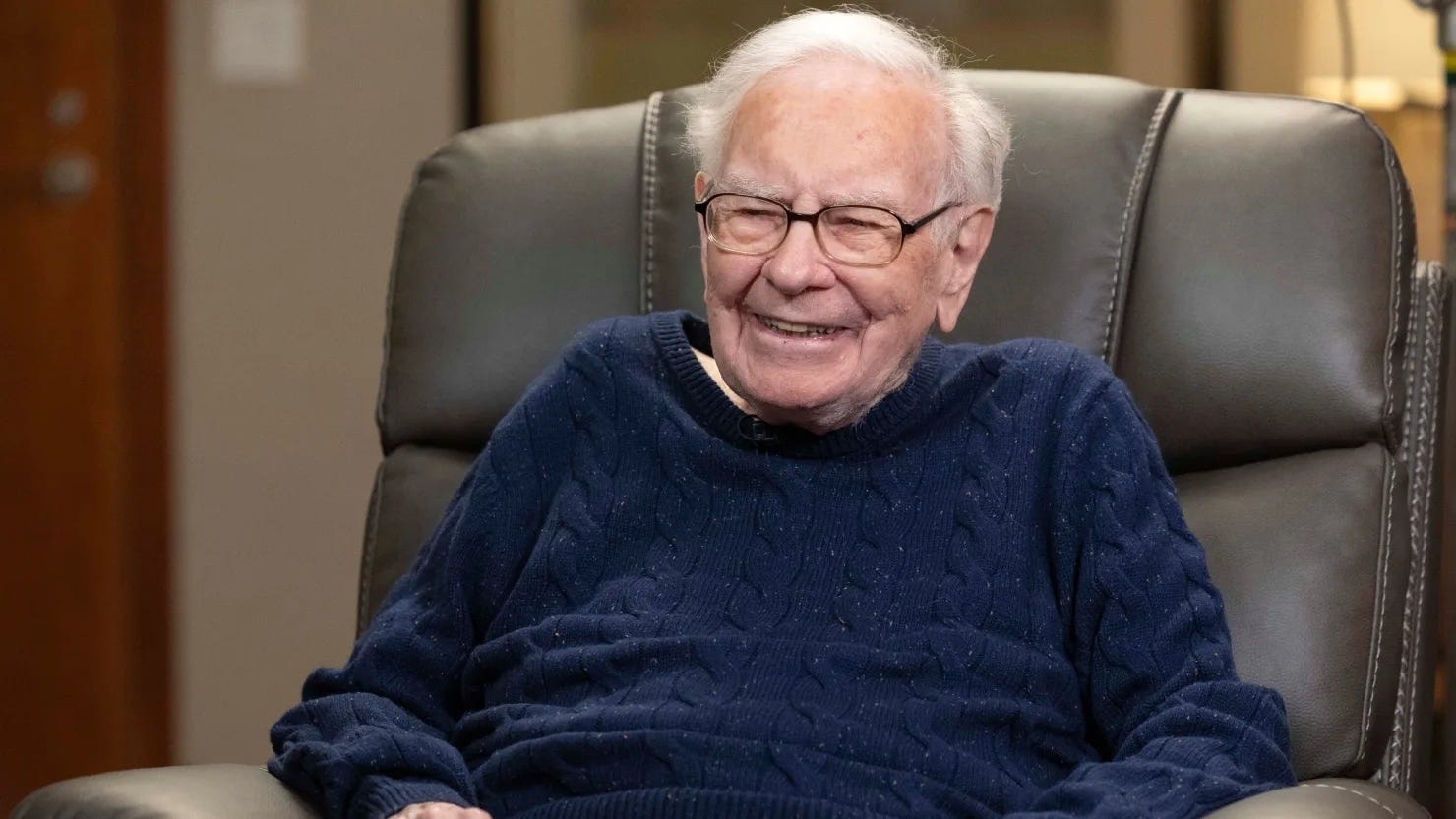
Warren Buffett says value is getting harder to find. Berkshire Hathaway is sitting on hundreds of billions of dollars in cash and Treasury bills, while Buffett looks at today’s market and sees more gambling, more promotion and fewer investments that make financial sense. Then he confirms that Berkshire’s Alphabet position is now worth more than $31 billion—and that it was his idea.
“I initiated it,” Buffett told CNBC’s Becky Quick on July 15. He immediately added an important qualification: Greg Abel approved the investment and, as Berkshire’s new CEO, remains the final decision-maker. But the original Alphabet idea came from the 95-year-old investor who spent most of his career explaining why technology lay outside his circle of competence.
At first glance, this looks like a contradiction. Buffett says bargains are scarce, yet Berkshire has built one of the largest positions in its portfolio in the middle of an artificial intelligence boom. The easy headline is that Buffett finally surrendered to AI. That misses the point. Buffett did not buy “AI.” He bought a business.
The reason Berkshire still holds an enormous cash pile while owning an Alphabet stake worth more than $31 billion is the most important part of the story. The cash and the investment are not opposing decisions. They are the same discipline.
The cash pile is not a market forecast
Investors love interpreting Berkshire’s cash balance as a prediction. Buffett must expect a crash. Buffett thinks the market is overvalued. Buffett is waiting to buy at the bottom. Perhaps he believes prices are broadly unattractive, but that does not mean he knows when markets will fall, how far they will fall or what will trigger the decline.
Buffett does not need a market forecast. He needs a hurdle rate. Every potential investment must compete against the return Berkshire can earn by doing almost nothing. With hundreds of billions invested in Treasury bills and other liquid securities, “doing nothing” now produces tens of billions of dollars in interest.
That changes the question. The question is not whether Alphabet is a good company. Almost everyone knows it is a good company. The question is whether owning Alphabet at the available price should produce a meaningfully better return than holding safe government securities.
Buffett made this comparison directly during the interview. Berkshire can place huge sums into Treasuries and receive $20 billion, $30 billion or even $40 billion in annual payments. Therefore, a business must earn substantially more than a near-riskless alternative—and continue doing so for a long time.
That is the filter. Most businesses fail it. Some have weak economics, some cannot reinvest, some depend on leverage and some operate in industries where competition quickly destroys excess returns. Others are wonderful businesses trading at prices that leave little room for error.
The cash pile is what remains after thousands of “no”s. It is not indecision. It is evidence that Berkshire refuses to lower its standards merely because capital is available.
What finally got a “yes”
Buffett was unusually restrained when discussing Alphabet. He did not call it Berkshire’s best business, nor did he say it was his favourite investment. He placed it around fifth or sixth when Berkshire’s wholly owned businesses were included and said there were at least four or five Berkshire businesses he preferred.
That may be the most revealing statement in the interview. Berkshire has more than $31 billion tied to a company that Buffett does not rank among its top four or five businesses. This is not hero worship. It is opportunity cost.
Alphabet did not have to be perfect. It had to be a better use of capital than the next available alternative. That distinction matters because investors often ask the wrong question: “Is Alphabet exciting?” Buffett asks: “Does Alphabet offer an attractive return relative to everything else I can do with this money?” One question produces narratives. The other produces decisions.
Buffett then returned to the principle Charlie Munger drilled into him for decades. A great business earns high returns on capital for an extended period. An even better business can reinvest part of those profits at similarly attractive rates. That is how compounding becomes powerful—not because the business has a fashionable product, not because revenue grows for several quarters and not because Wall Street labels it an AI winner, but because each retained dollar creates substantially more than one dollar of value.
Alphabet’s recent numbers explain why Berkshire paid attention. First-quarter revenue reached $109.9 billion, up 22%. Operating income increased 30% to $39.7 billion, while the operating margin expanded to 36.1%. Google Cloud grew even faster, with revenue rising 63% to $20 billion and Cloud operating income reaching $6.6 billion. Cloud backlog climbed to roughly $462 billion.
A company generating more than $100 billion of quarterly revenue is still growing above 20%. That is rare. Doing it while expanding margins is rarer. But impressive growth is not the same thing as a complete investment case. The real question begins where the headline numbers end.
Google used to fit Buffett’s perfect-business model
In Berkshire’s 2007 shareholder letter, Buffett described the ideal company: one that earns more money every year while requiring little additional capital. His examples were Microsoft and Google.
That version of Google was a near-perfect economic machine. Users searched, advertisers paid and Google collected a toll on human curiosity. The business grew without needing to build railroads, factories or thousands of physical stores. Incremental searches cost almost nothing compared with the advertising revenue they generated.
That was the dream model: rising earnings, little tangible capital and enormous returns on investment. Today, Alphabet plans to spend between $180 billion and $190 billion in capital expenditures during 2026. The company Buffett once praised for requiring almost no incremental capital has become one of the biggest capital spenders in corporate history.
Servers, chips, data centres, networking equipment, energy infrastructure, land, cooling systems and AI compute now absorb extraordinary sums of money. This is not a minor change in the business model. It is the entire investment question.
GEICO advertising or textile machinery?
Here is the filter every Alphabet investor should use: is this spending more like GEICO’s advertising budget or more like Berkshire’s old textile machinery?
GEICO spent money attracting customers. When the economics worked, every advertising dollar brought in policyholders whose lifetime value exceeded the acquisition cost. That spending widened the moat. More customers created scale, scale improved cost efficiency, lower costs supported better prices and better prices attracted more customers. The spending made an already strong business stronger.
Berkshire’s textile mills were different. They also required constant investment in new machinery, better equipment and more efficient production. But competitors made the same investments. Nobody gained a durable advantage. Customers received lower prices while owners received weak returns. Berkshire kept spending simply to remain competitive in a bad industry.
The capital maintained the business. It did not improve the economics. Both activities appeared as investment, but only one created value.
That is the test for Alphabet’s AI spending. If each new data centre strengthens Google’s products, lowers unit costs, improves models, attracts developers and locks customers deeper into its ecosystem, then the capex may be moat-building. Alphabet could emerge with a stronger Search franchise, a larger Cloud business and an infrastructure advantage smaller competitors cannot match. That would make the spending look like GEICO advertising.
But there is another possibility. Microsoft, Amazon, Meta, Oracle and other competitors may all spend hundreds of billions because none of them can afford to stop. In that world, the spending does not create differentiation. It merely prevents decline. Every company builds, every company buys chips and every company adds capacity. Customers gain more choices and lower prices, while shareholders carry the bill.
That would make AI infrastructure look more like textile machinery: huge spending, huge headlines and weak incremental returns. The winner will not be determined by who spends the most. It will be determined by who earns the best return on what they spend.
Buffett has not answered the question for us
Berkshire’s purchase does not prove Alphabet’s capex will create attractive returns. Buffett can be wrong. He says so himself.
During the interview, Buffett admitted that most of his decisions have not been extraordinary. Berkshire’s record was built from a relatively small number of exceptional outcomes, combined with patience and the avoidance of catastrophic errors.
That is another reason not to copy the position blindly. A famous investor buying a stock is evidence. It is not a conclusion.
Berkshire also received terms ordinary investors did not receive. In June, it purchased approximately $5 billion of Alphabet Class A shares at $351.81 and approximately $5 billion of Class C shares at $348.20. That brought the private placement to $10 billion.
The broader Alphabet stake was later described by CNBC as worth more than $31 billion. But “worth more than $31 billion” is not the same as saying Berkshire paid $31 billion. Part of that figure reflects the current market value of shares accumulated earlier.
That distinction matters. Cost is what Berkshire committed. Market value is what the market currently says the position is worth. Confusing the two exaggerates both Buffett’s original decision and the information available to 13F followers.
What investors should watch now
The Alphabet thesis will not be proved at an AI conference. It will be proved in the financial statements.
Start with operating income. Alphabet’s revenue may grow rapidly, but if operating profit grows much more slowly than capital spending, incremental returns could be deteriorating. Then watch depreciation. AI hardware may become obsolete much faster than traditional infrastructure. A data centre building may last decades, but the chips inside it may lose economic value within a few years. If equipment needs replacing faster than investors expect, today’s free cash flow may overstate the long-term economics.
Cloud margins matter too. The first-quarter improvement was excellent, but a strong quarter does not establish the return on hundreds of billions of dollars invested over several years. Backlog matters as well—but only with discipline. Alphabet’s Cloud backlog offers revenue visibility, not guaranteed profitability.
Backlog is not revenue. Revenue is not profit. Profit is not cash. And cash is not value unless the business earns an acceptable return on the capital required to produce it.
Investors must also watch Search. Search remains Alphabet’s economic engine and funds much of the AI buildout. If generative AI changes how people find information faster than Google can adapt its advertising model, Alphabet may be spending enormous amounts to defend the franchise that pays for everything else.
Finally, watch the share count. Alphabet is issuing equity despite generating enormous cash flow. Corporate growth does not automatically create shareholder value. A business can become larger while each existing owner receives a smaller portion of the economics. Revenue per share matters, free cash flow per share matters and intrinsic value per share matters. Size alone does not.
Why copying the 13F fails
Berkshire’s Alphabet position first appeared publicly after the buying had already started. That is how 13Fs work. Investors see a quarter-end holding weeks after the quarter has closed. They do not see the complete purchase history, valuation model, expected return or reasons for choosing one company over another.
The filing gives us the ticker. It does not give us the thesis.
We do not know Berkshire’s average cost, the valuation range Buffett considered acceptable, which assumption would cause him to sell or how the investment compares with Berkshire’s insurance float, Treasury income, operating subsidiaries and tax position. We do not know whether Berkshire intends to buy more, hold indefinitely or reduce the position.
The copycat receives the answer without seeing the calculation. That becomes a problem when the stock falls.
Imagine Alphabet drops 30%. Buffett can return to the financial statements. He can examine Search revenue, Cloud margins, capital intensity, cash generation, competitive position and incremental returns. The copycat can return only to one sentence: “Buffett bought it.”
That is not a thesis. It is borrowed confidence, and borrowed confidence disappears exactly when we need it most.
The copier owns a ticker. Buffett owns a thesis. Those are not the same asset.
The casino is a subsidy
Buffett’s criticism of gambling was not a warning that investors should avoid every popular company. It was a warning about process.
We can speculate in a great business if we buy without understanding its economics or without regard to price. We can invest rationally in a technology company if we analyse the durability of its cash flows and pay a sensible price. The ticker does not determine whether we are investing. Our reasoning does.
Today’s market is built to encourage action. Trading platforms need volume, Wall Street needs transactions and financial media needs new narratives. A person who buys Berkshire and holds it for 40 years generates almost no recurring revenue for the financial industry. A person trading weekly options can generate fees, spreads, engagement and advertising income every day.
That is why Buffett said there is more money in cultivating gamblers than investors. But the casino creates an advantage for anyone willing to remain outside it. When everyone focuses on next quarter, long-term economics are neglected. When everyone chases the same seven stocks, less glamorous businesses receive less attention. When price action becomes the analysis, mispricing can survive longer.
The stupidity of the crowd is not automatically our enemy. If we remain rational, it can become our subsidy.
The real lesson
There is no contradiction between Buffett saying value is scarce and Berkshire building a position worth more than $31 billion. The cash pile and the Alphabet investment came from the same rule: reject almost everything, wait, compare every opportunity with the next-best use of capital, then act decisively when a business finally clears the hurdle.
The lesson is not that we should buy Alphabet. Buffett’s price is not our price, his opportunity cost is not our opportunity cost and his position sits inside a conglomerate containing insurers, railroads, utilities, manufacturers, consumer brands and hundreds of billions of dollars in liquidity. Our portfolio is different.
The transferable asset is not the stock. It is the filter.
Does the business earn high returns on capital? Can it maintain them? Can it reinvest without destroying those returns? Is the capex widening the moat or merely defending it? Will growth increase free cash flow per share? And how long can the business remain wonderful?
Buffett’s Alphabet position is not interesting because a famous investor finally bought an AI company. It is interesting because it forces investors to confront the hardest question in modern technology investing: what happens when a capital-light compounder becomes a capital-heavy one?
If Alphabet’s nearly $200 billion annual investment produces durable, high-return growth, Buffett may have bought one of the few businesses large enough to move Berkshire’s needle. If the spending becomes an arms race that merely preserves market position, today’s Google may deserve a very different valuation from the Google Buffett praised in 2007.
We do not know the answer yet. That is why reading the 13F is not enough.
When our own Alphabet moment arrives, the filing will not tell us what to do. Our process will.