
Updated: JetBlue Put Options Rise as Structural Risk Gains Recognition
After Winter Storm Devin, JetBlue shares fell further while short-dated puts gained 18.75%, signaling early market recognition.

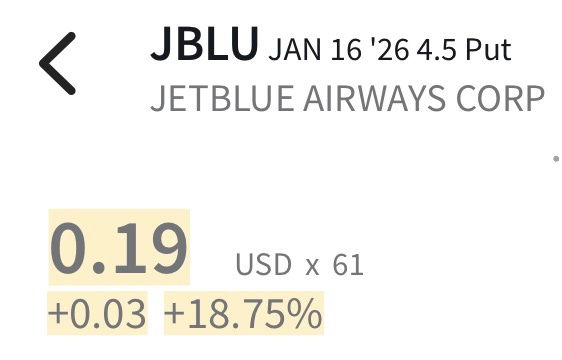
We wanted to follow up on our 27 Dec post on JetBlue after Winter Storm Devin, because the market response today is instructive—not as a conclusion, but as confirmation that the type of risk we discussed is beginning to be recognized.
To be clear upfront: this is not a victory lap. It’s a progress update on how structural risk gets priced.
What has happened since the original analysis on 27 Dec
Based on the framework we laid out, we initiated put option exposure in JetBlue, specifically the Jan 16, 2026 $4.50 put.
Within today (one day):
JetBlue shares declined a further ~3.4%, and
The put option moved approximately +18.75%.
Those moves matter less than why they occurred.
The market is not suddenly bearish on airlines.
It is slowly differentiating between temporary disruption and structural fragility.
That distinction was the core of the original thesis.
Re-Anchoring the Thesis: Weather vs Structure
The prevailing narrative remains that JetBlue “had a bad weather weekend.”
That framing is still incomplete.
Weather is a systematic risk.
Recovery is idiosyncratic.
If Winter Storm Devin were the primary driver, airlines operating the same geography would have shown broadly similar outcomes. They did not.
JetBlue canceled roughly 22% of its flights, while peers flying the same airports—JFK, LGA, and EWR—were closer to 5% or less. Same storm. Same runways. Very different results.
That divergence cannot be explained by snow or wind.
It can only be explained by internal operating constraints.
Why this became a structural event
Three elements mattered most:
1. Network concentration
JetBlue’s route architecture is heavily concentrated in the Northeast. When JFK, Boston, and Newark were impaired simultaneously, JetBlue had limited ability to reroute traffic or inject recovery capacity. Legacy carriers rely on geographically diversified “dry hubs.” JetBlue does not.
Once cancellations exceed roughly 15–20% of daily capacity, airline recovery dynamics turn non-linear. Backlogs compound faster than they can be cleared. That threshold was crossed quickly.
2. Fleet availability at the wrong moment
JetBlue entered the storm with a meaningful portion of its fleet already constrained due to mandatory Airbus software updates. Airline recovery depends on spare aircraft. JetBlue had very little slack. Peers with more diversified fleets could redeploy aircraft across unaffected sub-fleets. JetBlue could not.
This is not a judgment—it’s a structural design choice that worked well in calm periods and failed under stress.
3. Crew scheduling and human limits
Once disruptions exceed design parameters, crew scheduling systems break. Crews time out legally. Cancellations propagate after weather clears. At that point, airlines stop “catching up” and start resetting. Resetting is expensive, slow, and confidence-destroying.
Why the financial impact extends beyond the weekend
Holiday travel is one of the highest RASM periods of the year. Losing 25–30% of capacity for multiple days is material on its own.
But irregular operations carry multipliers:
crew overtime
refunds and compensation
interline rebooking at walk-up fares
reputational damage that affects forward bookings
Historically, major IROPS events cost 2.5–3.5x the direct revenue loss once secondary costs are included.
Conservatively, this points to a $60–80 million Q4 impact, before considering any Q1 drag from customer defection—particularly in JetBlue’s core Northeast markets.
That duration risk is what the market is only beginning to price.
What would invalidate the downside case
It’s important to be explicit here.
The thesis weakens materially if:
JetBlue demonstrates rapid, verifiable restoration of crew scheduling integrity, and
fleet constraints clear faster than current expectations.
Absent both, the risk-reward asymmetry remains skewed in the few months time.
Why this matters beyond JetBlue
Markets are very good at pricing:
weather
fuel
macro noise
They are much slower at pricing:
recovery capacity
redundancy
operational resilience
Structural fragility hides well—until it doesn’t.
Winter Storm Devin didn’t cause JetBlue’s current operational challenge.
It revealed them.
The initial option and equity moves are simply early recognition, not full repricing. Whether that repricing continues will depend on how quickly JetBlue can prove that this was a contained failure rather than a stress-test failure.
Disclosure & Disclaimer:
This commentary reflects the author’s personal opinions and analytical views based on publicly available information and does not constitute investment advice. The author long Jan 16, 2026 $4.50 put at the time of writing